
Shop Notes · Valley Diesels
Alaska winter diesel protection: oil, fuel and coolant
By Fredric Riech · 907 Synthetics · Wasilla, AK · (907) 350-7366
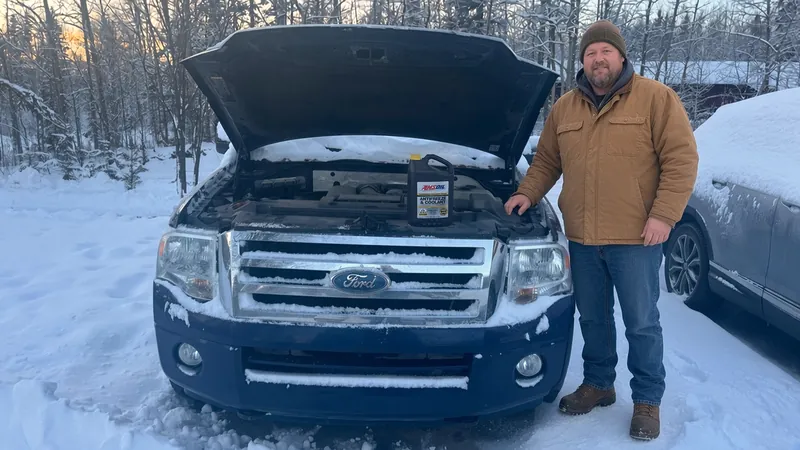
A diesel in the Mat-Su is a winter work truck first. It has to fire on a 20-below morning, idle at a job, and still have oil, fuel, and coolant doing their jobs when the Parks Highway is the commute. I already wrote the gelling, #1 versus #2, and Diesel Cold Flow walk in Keeping a diesel running through an Alaska winter. This is the three-system version: oil that moves at first crank, fuel that will still pass a filter, and coolant that will not freeze when the Valley actually gets cold.
I am an Independent AMSOIL Dealer in Wasilla. The bottles I name below are the ones I actually point people to for this climate. Confirm the viscosity and the coolant against the owner’s manual, or text me, before you guess.
Oil that still flows at first crank
Cold thickens diesel oil. The bearings, the turbo, and the rest of the parts that need a film at startup wait until that oil actually moves. A conventional 15W-40 that was fine in August can be slow to leave the pan when the truck has sat outside overnight in January. A premium synthetic diesel oil is built to stay more fluid in that first minute, which is when a lot of wear gets done.
For Alaska I usually start the conversation at AMSOIL Signature Series Max-Duty Synthetic Diesel Oil in 0W-40 — that is the grade I already specify on the winter diesel guide — and then we confirm it against the book. Some manuals want 5W-40, and that is a call I will make with you rather than guessing from a driveway. Max-Duty is AMSOIL’s top diesel line for severe service and wide temperature swings. I am not going to stretch a drain interval through a Valley winter just because the oil is a synthetic.
Short trips, plow work, and idling at the job are severe service here. They do not give the oil a long, hot highway run to cook off moisture and fuel dilution. If the truck lives on 10-minute hops around Wasilla or sits idling on a site, treat that as a hard-use cycle and change on the severe schedule the manual describes. A warmer oil grade that “worked in the Lower 48” is not automatically the right bottle for an Anchorage or Mat-Su morning.
Fuel that will still pass a filter
Diesel has wax in it. When the temperature drops, that wax starts to crystallize. The temperature where the fuel turns hazy is the cloud point. If those crystals grow enough to plug the filter, the engine is starved of fuel — that is the cold filter-plugging point, or CFPP. A lot of #2 diesel can start to cloud around freezing, and some poor fuel can do it even warmer. In the Valley we spend plenty of winter below both of those numbers.
Treat the fuel before the cold snap, not after the truck quits. Once the wax has come out of solution, an additive will not reliably put it back. Warm the system, get fuel moving again, and treat the next fill so the next morning is not a repeat.
AMSOIL Diesel Cold Flow is the dedicated cold-flow bottle. AMSOIL says it lowers the CFPP by up to 40°F in ultra-low-sulfur diesel, which is the fuel we actually buy at the pump. AMSOIL Diesel 4-IN-1 (sold as Diesel All-In-One) puts Cold Flow together with injector clean and cetane boost in one treat. AMSOIL lists the same kind of CFPP improvement on that bottle, plus a cetane bump of up to 4 points. The official treat rate on 4-IN-1 is one ounce per up to 2.5 gallons of fuel.
If the only problem in front of you is a coming snap and the fuel is already in good shape, Cold Flow is the more focused bottle. If you want cleanup, cetane, and cold flow from one jug, 4-IN-1 is the one I walk people through. For the deeper note on #1 versus #2, winter blends at Valley stations, and how I time Cold Flow, stay with the existing winter diesel post. I am not rewriting that walk here.
Coolant is a winter product up here
People think of antifreeze as a summer overheating product. In Alaska it is a freeze product first. A weak mix, a neglected change, or a cooling system that has never been checked will wait until a genuine cold morning to become a cracked-block conversation.
AMSOIL sells two ethylene-glycol formulas that I point diesel owners to, both as 50/50 pre-mix with high-purity water, and AMSOIL lists freeze protection on that pre-mix down to −34°F. That number matters here. A typical Anchorage night may stay above it. A genuine Mat-Su or interior morning can go below it. A 50/50 fill is not automatically “Alaska-proof.” Check the concentration with a coolant tester, or have a shop check it. Follow the owner’s manual, and do not invent a richer mix on a guess — too much glycol can hurt heat transfer. If the truck lives through colder snaps than the official 50/50 rating, that is a conversation with the manual and a shop test, not a driveway experiment.
Light-duty diesel pickups take AMSOIL Passenger Car/Light Truck Antifreeze & Coolant. AMSOIL rates that protection at up to 150,000 miles or 5 years, whichever comes first. Heavy-duty trucks and equipment take AMSOIL Heavy-Duty Antifreeze & Coolant, which is fully formulated — AMSOIL says it does not require supplemental coolant additives or extenders — and is rated at up to 1,000,000 miles, 20,000 hours, or eight years, whichever comes first. Use the formula that matches the machine, not the jug that happens to be on the shelf.
Block heaters, batteries, and idling
Plug the truck in. In this climate that is not optional courtesy; it is how you keep the engine and the batteries in a range where a start is fair. A block heater warms the coolant and helps the engine fire. It does not replace oil that will flow at first crank, or fuel that will still pass a filter, and it does not fix a weak battery at 20 below. If the truck is slow to crank on a cold morning, look at the batteries before you blame the oil.
Do not use all-night high idle as a substitute for a heater and a treated tank. Idling and short trips are hard on oil, and they do not always get the fuel system warm enough to shrug off a gel risk. I will tell you when a job belongs in a shop. I would rather answer a two-minute question now than hear about a no-start on the Parks at 6 a.m.
Video · 2:08
Watch: How to keep your diesel running strong during winter
AMSOIL’s official film on winter diesel fuel, cold flow, and the habits that keep a truck from becoming a morning project. I already place this on the winter diesel guide; it belongs here too.
The bottles I would put on a Valley diesel
Pack shots below are from the AMSOIL Digital Library.
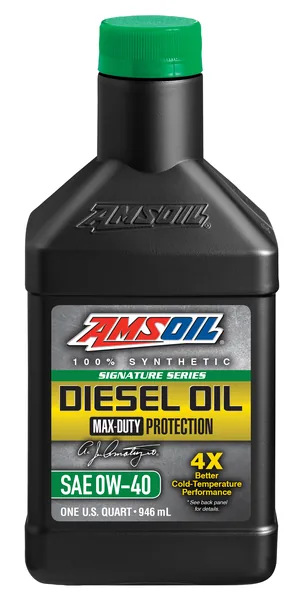
Signature Series Max-Duty 0W-40
The Alaska winter grade I usually start with. Confirm it against the owner’s manual.
Shop Max-Duty 0W-40Reproduced with the permission of AMSOIL INC. All rights reserved.
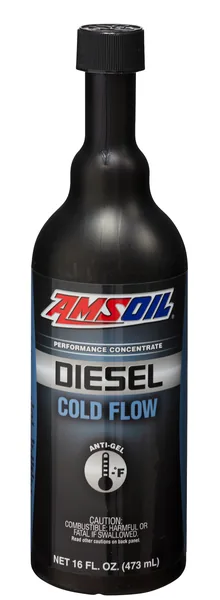
Diesel Cold Flow
The dedicated cold-flow bottle. AMSOIL says it lowers CFPP by up to 40°F in ULSD. Treat before the snap.
Shop Diesel Cold FlowReproduced with the permission of AMSOIL INC. All rights reserved.
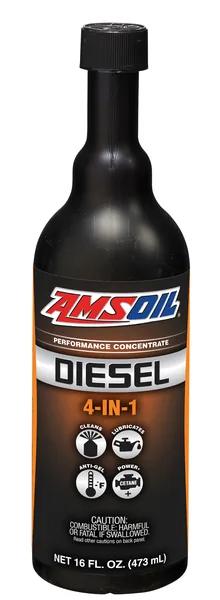
Diesel 4-IN-1 (All-In-One)
Cold flow, injector clean, and cetane in one treat. Official rate: 1 oz. per up to 2.5 gallons.
Shop Diesel 4-IN-1Reproduced with the permission of AMSOIL INC. All rights reserved.
Passenger Car/Light Truck Antifreeze & Coolant
For light-duty diesel pickups. 50/50 pre-mix; AMSOIL lists freeze protection to −34°F, and protection up to 150,000 miles or 5 years.
Shop light-duty coolantHeavy-Duty Antifreeze & Coolant
For heavy-duty trucks and equipment. Fully formulated (no SCAs). AMSOIL lists freeze protection to −34°F, and protection up to 1,000,000 miles, 20,000 hours, or 8 years.
Shop heavy-duty coolantA short winter checklist
- Confirm the Max-Duty grade against the owner’s manual. In this climate I usually start at 0W-40. Change on the severe schedule if the truck idles, plows, or makes short trips.
- Treat the next fill with Diesel Cold Flow or Diesel 4-IN-1 before the snap, not after a gel-up. Follow the label dose.
- Check coolant concentration, not just the color in the overflow. Know whether the truck takes the light-duty or heavy-duty AMSOIL formula. Remember the official 50/50 rating is −34°F.
- Plug in the block heater, and make sure the batteries will still crank at the temperature you actually park in.
- If you are not sure which bottle, use the AMSOIL lookup tagged to 1245102 or text me. I would rather get this right in November than sort out a no-start in January.
Questions about a Valley diesel?
Call or text 907-350-7366 — Fredric Riech, 907 Synthetics, Independent AMSOIL Dealer, Wasilla, AK.