
Shop Notes • Snowmachines
INTERCEPTOR® or DOMINATOR®? Picking Two-Stroke Oil for an Alaska Sled
By Fredric Riech · 907 Synthetics · Wasilla, AK · (907) 350-7366
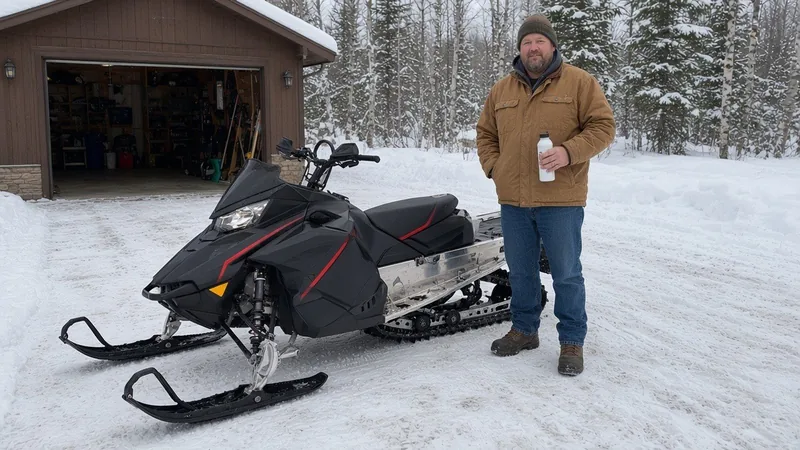
Every fall, once there is enough snow to ride, I get the same question by email and by text: “Should I run INTERCEPTOR® or DOMINATOR® in my sled?” Both are AMSOIL synthetic two-stroke oils. Both are good oils. They are just built for different jobs, and picking the wrong one for how you ride doesn’t help your engine.
Here is how I walk folks through it, for the way we actually ride up here: cold starts in the driveway, long trail days out of Big Lake and Willow, deep snow in Hatcher Pass and up the Petersville Road, and a long summer in the shed. Where I quote a number, it comes from an AMSOIL data sheet or test that I link to, so you can check it yourself.
The Short Answer
- Stock trail, crossover, mountain or utility two-stroke: INTERCEPTOR®. That includes factory turbo two-strokes; AMSOIL ran its own turbo tests on INTERCEPTOR®.
- Race sled, or an engine you have modified (pipes, porting, clutching, carb or fuel work, aftermarket boost): DOMINATOR®.
- Four-stroke sled: neither. Those take a crankcase motor oil, not a two-stroke oil.
That is also AMSOIL’s own answer in its post INTERCEPTOR vs. DOMINATOR: Which Snowmobile Oil Should I Use? The rest of this post is the why, and the Alaska details. If you just want the spec table and quick answers, see my INTERCEPTOR® vs DOMINATOR® comparison page.
What Each Oil Is Built to Do
INTERCEPTOR®: the everyday sled oil
AMSOIL calls INTERCEPTOR® its “best all-around snowmobile oil.” The way I explain it: it is a balanced oil. It has to protect pistons and bearings, but it also leans hard on two things that matter on a normal sled: keeping the exhaust power valves clean so they keep moving, and flowing in the cold so oil gets where it needs to go at startup.
Modern injected two-strokes (Rotax E-TEC, Polaris direct-injection engines, Arctic Cat C-TEC2) meter very little oil, and the computer can lean the oil ratio out depending on conditions. Less oil doing more work is exactly why oil choice matters on these sleds. AMSOIL lists INTERCEPTOR® for oil injection or 50:1 premix, and it meets API TC and JASO FD. It also lists it for E-TEC and C-TEC2 engines, plus carbureted and EFI two-strokes.
DOMINATOR®: the race oil
DOMINATOR® is AMSOIL’s two-stroke racing oil. AMSOIL builds it on heavier synthetic base oils for engines running higher compression, higher rpm and leaner, hotter combustion. In other words, race engines and engines somebody has modified to make more power than the factory built them for. The focus is film strength and wear protection under that kind of heat and load.
The trade-off is the part most people miss. AMSOIL says plainly that because DOMINATOR® puts wear protection first, it doesn’t guard against power-valve sticking as well as INTERCEPTOR® does. On a race sled that gets torn down and gone through all the time, that trade makes sense. On a trail sled that sees one valve cleaning a season (if that), it doesn’t.
Side by Side: The Numbers
These are AMSOIL’s typical properties from the current data sheets (INTERCEPTOR®, G1955 and DOMINATOR®, G1985, both dated January 2025). Typical values, not guarantees.
| INTERCEPTOR® | DOMINATOR® | |
|---|---|---|
| AMSOIL’s intended use | All two-stroke snowmobiles; its best all-around sled oil | Racing and modified two-strokes |
| Pour point (ASTM D97) | −53°C (−63°F) | −54°C (−65°F) |
| Viscosity at 100°C / 40°C | 6.5 / 30.7 cSt | 7.0 / 35.2 cSt |
| Viscosity index | 172 | 166 |
| Flash point (ASTM D92) | 102°C (216°F) | 94°C (201°F) |
| Specs listed | API TC, JASO FD; passes the SAE J1536 Arctic Climate grade test | API TC |
| How to use | Oil injection, or 50:1 premix (2.6 oz. per U.S. gallon) | Oil injection or premix; 50:1 (2.6 oz. per U.S. gallon) in premix, though AMSOIL notes many racers adjust the ratio |
| Power valves | AMSOIL’s pick for valve cleanliness | Compatible with power valves, but AMSOIL says it guards against sticking less well than INTERCEPTOR® |
Two things jump out. First, the pour points are within 2°F of each other, so neither one is a “cold oil” and the other a “warm oil.” Second, DOMINATOR® is the slightly thicker oil, which fits its job: a heavier film for a hotter, harder-working engine.
Match the Oil to How You Actually Ride
This is the honest version, sled by sled. I would rather sell you the right bottle than the more exciting one.
- Trail riders (Big Lake, Willow, Knik, the Susitna side): INTERCEPTOR®. Long days at mixed speeds, lots of idling at trail junctions and fuel stops. Clean power valves and cold flow matter more to you than race-day film strength.
- Mountain and backcountry riders (Hatcher Pass, Petersville, Turnagain, the Eureka side): still INTERCEPTOR® on a stock sled, even a big-bore one. Deep powder is hard on an engine, but it is the work these sleds are built for. AMSOIL’s own field test put INTERCEPTOR® in a rental mountain sled for a full season in British Columbia (more on that below).
- Factory turbo two-strokes: INTERCEPTOR®. AMSOIL tested it on the dyno in a Ski-Doo 850 E-TEC Turbo R and a turbocharged Polaris Switchback Assault Boost. If you have added boost to an engine that didn’t come with it, or turned the boost up past stock, text or email me. That starts to look like a modified engine.
- Modified engines: DOMINATOR®. If you have changed pipes, porting, compression, clutching or fuel to make more power, you have added heat and stress. That is where AMSOIL points DOMINATOR®. Plan on keeping a closer eye on your power valves.
- Racers: DOMINATOR®. Snocross, cross-country, hill climbs, drags. Follow your engine builder on the premix ratio.
- Older carbureted sleds and work sleds (the trapline machine, the cabin sled, the one that hauls a freight sled): INTERCEPTOR®, as long as the owner’s manual calls for an API TC-type injection oil. AMSOIL also makes a 100% Synthetic 2-Stroke Injector Oil that it suggests for casual riders who want one oil for the sled and a two-stroke outboard. Ask me if that is you.
- Four-strokes: none of the above. A four-stroke sled needs the crankcase oil its manual specifies. Look it up in the AMSOIL snowmobile lookup.
Cold Starts at Forty Below
On an injected sled, the oil pump has to pull oil from the tank and push it through small lines to the engine the moment it fires. If the oil is too thick to move, the engine runs short on oil right when it needs it most. That is why cold flow gets so much attention.
AMSOIL lists INTERCEPTOR® at −63°F pour point and as passing the SAE J1536 Arctic Climate test, and its −40°F cold-flow comparison pours INTERCEPTOR® side by side with the three big sled makers’ own oils after time in a −40°F freezer. Keep in mind that a pour point is a lab number. It tells you the oil still moves; it doesn’t promise the sled will start or that you can skip a warm-up.
Habits that help in a Valley cold snap:
- Top off the oil tank in the garage, the night before, not at the trailhead with frozen fingers. Wipe the cap area first so snow and grit stay out of the tank.
- Never let the injection tank run low. Most sleds have a low-oil light; treat it as “stop and add oil,” not “soon.” If a tank ever runs dry, check your manual before you ride. Some oil pumps need to be bled.
- Carry a spare quart in the truck or your pack, ideally the same oil that is in the tank.
- Warm it up the way your manual says before you pin it, especially after a night at twenty below.
Oil-Injected or Premix?
Most modern sleds are oil-injected: the pump meters the oil and you just keep the tank full. Do not add oil to the gas on top of that unless your manual tells you to. Some manuals call for a premixed first tank during break-in.
If you run premix, AMSOIL’s ratio for both oils is 50:1, which works out to 2.6 ounces per U.S. gallon. Racers running DOMINATOR® often set their own ratio with their engine builder; that is their call, not something I’d guess at for you. For everyone else:
- Use a marked mixing bottle and measure every time. Don’t pour by eye.
- Mix in the garage before you load up, not on the tailgate at the trailhead.
- Mix only what you will burn soon, and label the can so the premix doesn’t end up in the truck or the snowblower.
Fuel: Ethanol, Octane and the Long Summer
The oil can only do its job if the fuel is right. Use the octane your sled’s manual calls for. Most Alaska gas stations sell fuel without ethanol, unlike the Lower 48, so up here that is one less thing to worry about. One note from AMSOIL’s data sheet: DOMINATOR® is not for use with alcohol or nitromethane race fuels.
If you trailer the sled Outside to ride, or fill a can somewhere that does sell E10, keep in mind that ethanol-blended fuel is more prone to picking up water and going stale over a long sit. Either way, our sleds sit from breakup to first snow, so before storage either stabilize the fuel the way your manual describes or follow its procedure for draining it. In the fall, if the gas smells off or looks cloudy, don’t try to save it.
Power Valves: Where Oil Choice Shows Up
Exhaust power valves sit right in the hot exhaust stream and open and close the exhaust port to give you low-end response and top-end power. Carbon from burned oil and fuel builds up on them, and a sticky valve costs power. AMSOIL’s power valve cleaning how-to notes that most manufacturers call for cleaning them seasonally, so check your manual.
This is the real dividing line between the two oils. INTERCEPTOR® is AMSOIL’s pick for valve cleanliness. DOMINATOR® trades some of that away for wear protection. Up here we do a lot of the riding that builds carbon: idling while the group catches up, breaking trail, hauling a freight sled slowly, and short rides around the cabin. That is one more reason a stock sled belongs on INTERCEPTOR®.
Switching Oils, Warranty and Peace of Mind
Switching: you don’t need to drain the tank or flush anything. AMSOIL says both oils are compatible with most other two-stroke oils, but that mixing should be kept to a minimum for best performance. Run the old oil down, fill with the new one, and stick with one oil from then on.
Factory warranty: AMSOIL’s DOMINATOR® data sheet calls it Warranty Secure®, meaning using it keeps your sled’s factory warranty intact, and AMSOIL backs both oils with its limited lubricant warranty. If you have a warranty question on a new sled, text or email me before you switch and we’ll look at the paperwork together.
AMSOIL’s sled warranty: if you run INTERCEPTOR® exclusively in a current-model-year or newer sled and register it, AMSOIL’s Runs on Freedom® Limited Snowmobile Warranty covers engine repairs for up to two years or 5,000 miles (8,000 km). AMSOIL’s warranty explainer says you can register a qualifying sled up to 18 months after you take delivery. This applies to INTERCEPTOR® only, not DOMINATOR®. Read the terms on AMSOIL’s page before you count on it.
The Proof: AMSOIL’s Case Studies and Tests
Fair warning: these are AMSOIL’s own tests and stories, not independent studies. They are still worth reading, because they show what AMSOIL took apart and how it rated the parts.
- 3,469-Mile Case Study in Rotax® E-TEC® Engine (G3038, PDF). A 2011 Ski-Doo TNT 800R run on INTERCEPTOR® from new. When a factory recall replaced the pistons at 3,469 miles, an independent rater found no piston scuffing and no ring sticking. It is an older study (2012) of one sled.
- Grizzly Lodge rental-sled test. A new 2019 Polaris RMK 850 rental sled ran INTERCEPTOR® in the British Columbia mountains from December 2018 to February 2019, 1,617 miles per the AMSOIL performance tests page. AMSOIL reports the power valves stayed free and the pistons kept nearly all their coating. That is the closest match to how a lot of us ride Hatcher Pass.
- 50 Hours: Arctic Cat ZR 858 R-XC. A dyno test of INTERCEPTOR® in the newer 858 C-TEC2 engine, which AMSOIL says equals more than 2,000 trail miles, followed by a teardown.
- AMSOIL Snowmobile Oil Is Engineered for Extremes. A roundup of the turbo dyno tests (Ski-Doo 850 E-TEC Turbo R, Polaris Switchback Assault Boost) and the DOMINATOR® race-engine story.
- AMSOIL 2-Stroke Oil Saves Racing Engine. The DOMINATOR® side: a pro snocross sled lost its coolant mid-race, and AMSOIL reports the engine got hot enough to melt the power-valve covers and gaskets, yet the team was able to reuse it after a teardown.
- AMSOIL INTERCEPTOR Powers 40,000-Mile Snowmobile. A customer story: a Michigan rider’s Polaris XCR800 passed 40,000 miles on INTERCEPTOR® without the engine ever being opened up. One sled and one owner, but a good read.
AMSOIL has moved its older 2012 E-TEC dyno study (G3039) into its archive, with a note that archived tests may not reflect current formulas, so I haven’t linked it here.
Watch: AMSOIL’s Own Videos
All of these are on AMSOIL’s official YouTube channel. They open on YouTube.
- INTERCEPTOR Cold Flow Test (1:50). Oils poured side by side after time in a −40°F freezer.
- Grizzly Lodge Rental Torture Test (2:55). A full season in a rental mountain sled, then the teardown.
- AMSOIL Snowmobile Oil Testing: Real-World Engine Teardowns & Dyno Results (1:44). A quick overview of AMSOIL’s sled engine teardowns across the major brands.
- Arctic Cat ZR RXC 858 Proof of Performance (4:54). The 50-hour dyno test, part by part.
- AMSOIL INTERCEPTOR® Torture Ride (1:49). A Ski-Doo 850 E-TEC Turbo R run 30 hours on the dyno, then torn down.
- Polaris Switchback Assault Boost Torture Test (1:23). The factory turbo Polaris, in the lab and on the trail.
- Scheuring Speed Sports Testimonial (1:43). The DOMINATOR® race engine that lost its coolant.
- Stock Vs. Race Sleds – What’s the difference? (8:54). A snocross team mechanic and racer walk through how a trail sled becomes a race sled. It is a good gut check on whether your sled is actually “modified.”
Putting the Sled Away for an Alaska Summer
Our storage season is longer than our riding season, so it is worth doing right. Follow your manual’s storage procedure. In general:
- Run the sled on the oil you plan to use next winter, so the pump and lines are full of it, and leave the oil tank topped off.
- Fog the engine the way your manual describes. Some two-stroke sleds have a built-in fogging setting.
- Deal with the fuel: stabilize it or drain it, per the manual.
- Check the chaincase oil. Milky oil means water got in.
- Store it somewhere dry, off the ground, and covered.
AMSOIL’s snowmobile summer storage checklist goes through each step. And if you trailer your sled, read my post on repacking trailer bearings before snowmachine season. A seized hub on the Parks Highway ends the trip just as fast as a seized piston.
Sled Oil Checklist
- Engine type: two-stroke (INTERCEPTOR® or DOMINATOR®) or four-stroke (crankcase oil per the manual)
- Stock or modified: stock, including factory turbo, means INTERCEPTOR®. Modified or raced means DOMINATOR®.
- Oil tank: topped off in the garage, low-oil light never ignored
- Premix: measured at 50:1 (2.6 oz. per U.S. gallon) unless your engine builder says otherwise
- Fuel: the octane your manual calls for, and a look at the pump label if you fuel up Outside
- Power valves: cleaned on your manual’s schedule, more often on DOMINATOR®
- Spare quart: in the truck or pack, the same oil as in the tank
- Warranty: new sled on INTERCEPTOR®? Register for Runs on Freedom®.
Oils for This Job
For stock two-stroke sleds, trail to mountain: AMSOIL INTERCEPTOR® 100% Synthetic 2-Stroke Oil.
For racing and modified two-strokes: AMSOIL DOMINATOR® 100% Synthetic 2-Stroke Racing Oil.
For one oil across a casual sled and a two-stroke outboard: AMSOIL 100% Synthetic 2-Stroke Injector Oil.
For chaincase oil and four-stroke sleds, look up your exact model in the AMSOIL snowmobile lookup and compare it to your owner’s manual. These links carry my dealer number so AMSOIL credits 907 Synthetics with your order. More on the sled lineup is on my snowmobile oil page, and ordering details, including Anchorage pickup at Carlile on Spar Ave., are in how to buy AMSOIL in Alaska. If you ride a lot, ask me about becoming a Preferred Customer before you check out.
Ski-Doo, Rotax, E-TEC, BRP, Polaris, RMK, Switchback, Arctic Cat, C-TEC2 and other names mentioned are trademarks of their respective owners. No affiliation or endorsement is claimed or implied.
Related: INTERCEPTOR® vs DOMINATOR® comparison · Snowmobile oil · Repack your trailer bearings
Not Sure Which Bottle Your Sled Needs?
Tell me the year, make, model and engine, whether it has been modified, and how you ride it. I’ll give you a straight answer, even if that answer is “the oil you already have is fine.” Wasilla and Palmer riders, I’m local. Most of my customers email or text me, and that works best for me too.
Text 907-350-7366 or email sales@907synthetics.com — Fredric Riech, 907 Synthetics, Independent AMSOIL Dealer, Wasilla, AK
Did this help? Leave 907 Synthetics a Google review. It helps other Valley folks find local help.