
Shop Notes · Valley Warm-Ups
Why a Wasilla Truck Takes So Long to Throw Heat at 20 Below
By Fredric Riech · 907 Synthetics · Wasilla, AK · (907) 350-7366
It’s 20 below in the driveway. The truck starts, you give it a minute, and the cab still feels like a walk-in freezer. The gauge barely moves. You finally roll down the Parks with the blower on high, and the first real heat shows up about the time you get to work.
That is a Mat-Su morning, not a mystery. A lot of people blame the thermostat, or the oil, or “this truck just does that in winter.” Sometimes those are part of it. A lot of the time the story is simpler: at 20 below, the engine has to heat a big, cold cooling system before any of that warmth can reach your feet.
I am Fredric Riech with 907 Synthetics here in Wasilla. This is the driveway version of why warm-up feels so slow up here, what coolant actually does in that process, the checks I want you to do before the deep cold, and where AMSOIL® DOMINATOR® Coolant Boost fits — including what it does not do.
Why warm-up is slow at 20 below
An engine makes heat as soon as it is running. The problem is everything around it is trying to steal that heat. The block, the heads, the coolant in the jackets, the oil, the heater core, the radiator, and the air moving through the bay are all sitting at whatever the Valley decided to do last night. At 20 below, that is a lot of cold metal and cold fluid to bring up together.
The thermostat is supposed to stay closed until the coolant is warm enough, so the engine can heat itself instead of dumping warmth through the radiator right away. That is good design. It is also why a short idle in the driveway often feels like nothing is happening. The thermostat is not stuck. The coolant is still too cold to open it.
Your toes do not get heat until hot coolant is moving through the heater core. If the gauge is still low, the core is still low. Sitting in the driveway with the blower on high can actually slow the warm-up a little, because you are pulling heat out of a system that has not stored much yet. A short idle to get oil pressure and a clear windshield is reasonable. A ten-minute camp-out with the heater pinned is mostly just burning fuel.
Oil matters too, especially on the start itself. A grade that is too thick at 20 below makes the engine work harder and delays the moment things start to feel normal. I wrote that up separately in the viscosity guide. This article is the other half of the same cold morning: the cooling system, and the heat that is supposed to end up in the cab.
How coolant actually moves the heat
Coolant is not just “antifreeze” so the block does not crack. It is the delivery system for heat. Combustion heats the metal. The metal heats the coolant in the jackets. Once the thermostat opens, that coolant moves through the radiator to dump extra heat, and through the heater core so the blower has something useful to push into the cab.
For that to work well, two things have to be true. The system has to be full, because air does not carry heat the way liquid does. And the coolant has to wet the metal well — it has to actually contact the surfaces inside the engine, the radiator, and the heater core. Old fluid, scale, rust, or a mix that has been topped off with whatever was handy can get in the way of that contact. You feel it as a long wait for heat, or a heater that never gets as hot as it should, even after a highway run.
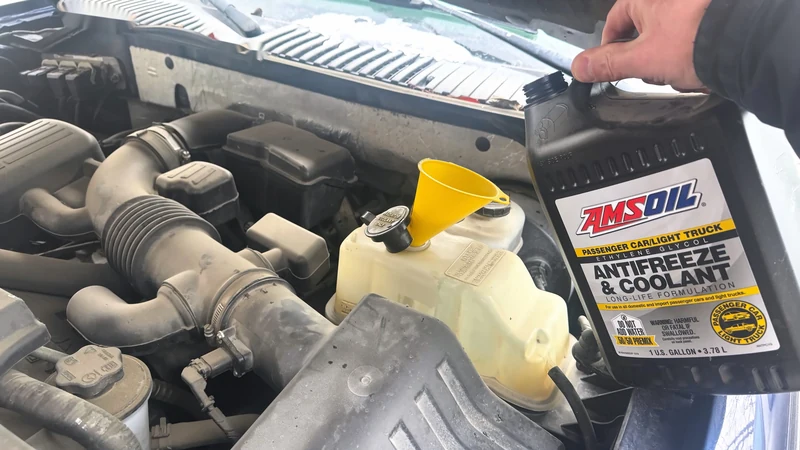
Freeze protection is the other job, and in Alaska it is not optional. Water alone transfers heat very well, which is why some racing setups run it, but water in a street truck at 20 below is how you turn a cooling system into a block of ice. Daily drivers up here need a proper antifreeze mixture, at a strength that actually covers the coldest night your truck sits. The gallon in the photo is AMSOIL Passenger Car/Light Truck Antifreeze & Coolant, a 50/50 premix. The chemistry also has to match what the manufacturer specified. Coolant types are not all interchangeable.
The driveway coolant checks
Do this with the engine cold. A hot cooling system is under pressure, and cracking a cap can spray scalding fluid. I walk through the six-fluid version of this in the pre-winter fluid check; here is the cooling-system part I would not skip.
- Level: Look at the overflow tank and make sure the coolant sits between the cold-fill marks. A low tank is air, and air does not heat the cab.
- Condition: It should look clean and bright. Rusty, muddy, oily, or slimy coolant is a shop conversation, not a top-off job.
- Freeze protection: Level is only half of it. Have the mix tested before the first real snap, not during it. Mat-Su and the Valley floor sit far below zero, and years of topping off with plain water quietly weaken the protection.
- Leaks and smells: Dried coolant at a hose, a crusty pump weep, a sweet smell in the cab, or a puddle on the snow are reasons to stop and get it looked at. Adding an additive on top of a leak does not fix the leak.
- Type: If you need to add coolant, use the type the manufacturer specifies. Mixing chemistries can cause problems you will not see until later.
If any of that looks off, fix the basics first. An additive is not a substitute for a system that is low, leaking, or filled with tired fluid.
What DOMINATOR® Coolant Boost does — and does not do
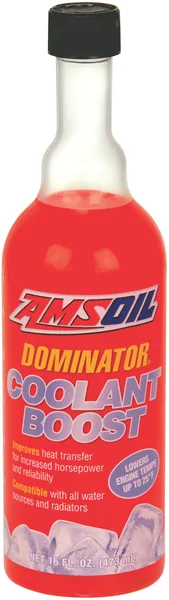
Once the cooling system is sound, there is a product I want Valley truck owners to know about: AMSOIL DOMINATOR® Coolant Boost. It is a 16-ounce treatment you add to the cooling system. AMSOIL makes it for both straight-water racing systems and everyday antifreeze-and-water mixtures, and describes it as radiator-safe. You can read AMSOIL’s current product page here.
I am not going to dress this up as something I measured in my own driveway. Here is what AMSOIL says the product is for, in my words. The treatment uses surfactants — wetting agents — so the coolant makes better contact with the metal. Better contact means heat moves in and out of the liquid more readily. AMSOIL’s figures are a reduction in engine temperature of up to 25°F, and vehicles that warm up an average of 54 percent faster. The same bottle also carries corrosion inhibitors aimed at the radiator, heater core, water pump, and the other metal in the system.
That faster-warm-up claim is the reason this belongs in a Wasilla conversation. If the coolant can pick up heat from the metal sooner, and give it up at the heater core sooner, the cab should start to feel like a cab before you are already at the job site. It is still a figure from AMSOIL, not a promise that every Valley truck will throw heat in half the time.
Here is what it does not do. It does not replace a proper antifreeze mixture. It does not replace a thermostat. It does not replace a block heater on a 20-below morning. It does not fix a failing water pump, a stuck thermostat, a clogged heater core, low coolant, or a leak. If those are your problems, start there.
Dose, how to add it, and how often
For a daily driver with an antifreeze mixture — which is what almost every street truck in the Mat-Su should have — AMSOIL’s dose is 1 fluid ounce of Coolant Boost per quart of cooling-system capacity. Check your owner’s manual for that capacity. Do not guess, and do not size it off a buddy’s pickup. The same label has a higher dose for straight-water racing systems: 2 fluid ounces per quart. That is not a recommendation for a truck that sits outside in Wasilla. Straight water will freeze. Use the antifreeze-mix dose in a street vehicle, in a system already filled with the correct coolant.
AMSOIL’s directions are straightforward. The engine should be off and cool, and the system should already be filled. Shake the bottle, pour it into the radiator, start the engine, put the heat on high, and let it run about 15 minutes so the treatment can circulate. On a lot of late-model pickups the fill point you can actually get to is the overflow tank, not an old-style radiator cap. Use the fill point your owner’s manual shows, and never open a hot, pressurized system.
For antifreeze-filled systems, AMSOIL’s interval is once a year or every 30,000 miles, whichever comes first. Follow the coolant manufacturer’s change interval for the fluid itself. The boost is a treatment, not a reason to skip a flush when the coolant is due.
The product is compatible with antifreeze-and-water mixtures and with distilled, bottled, or tap water in the systems it is made for. Compatibility is not a green light to mix random stop-leaks, sealers, or a different coolant chemistry on top of whatever is already in the truck. Keep the base coolant correct, then treat it.
Reproduced with the permission of AMSOIL INC. All rights reserved.
Video · 3:20
Watch: How to help a vehicle warm up faster
AMSOIL’s official film on DOMINATOR® Coolant Boost, and how it helps a vehicle come up to temperature faster in the cold.
Block heaters still earn their plug
If you already plug in on a 20-below morning, keep doing it. A block heater warms the engine and the coolant before you turn the key, which is the most reliable way to shorten the ugly part of a Valley start. Coolant Boost is not a substitute for that cord.
Use a heavy-duty, outdoor-rated cord, keep the connection out of the snow, and give it enough hours to actually do some good — overnight is the usual habit here, not a ten-minute plug-in while you finish your coffee. If the heater is dead, the cord is warm and the block is still stone cold, or you smell coolant around the heater element, that is a shop job. Do not keep feeding a heater that is leaking or not heating.
When to call a pro
Some of this is driveway work. Some of it is not. Call a shop, or call me for a referral, if:
- The heater blows cool after a long drive and the gauge is up where it should be. That can be a heater core, a blend door, or circulation, and it is easy to guess wrong.
- The engine runs hot, or the gauge never leaves the bottom after a real highway run.
- You have rust, sludge, oil in the coolant, or a persistent leak.
- You do not know what chemistry is in the system, or it has been topped off with whatever was on sale for years.
- You are not comfortable opening the fill point, even with the engine cold.
A cooling system that fails in January is not a small inconvenience. It is a tow, a possible cracked component, and a very long wait on the side of the road. The cheap time to deal with it is a Saturday in the driveway, before the real cold sets in.
Want a sanity check before the next cold snap?
If you want help reading a freeze-protection result, sizing a Coolant Boost dose off the capacity in your manual, or deciding whether the coolant itself is due for service, text or email me. I would rather answer a two-minute question now than hear about a truck that never threw heat on the way to Anchorage.
Call or text 907-350-7366 — Fredric Riech, 907 Synthetics, Independent AMSOIL Dealer, Wasilla, AK
Did this help? Leave 907 Synthetics a Google review. It helps other Valley folks find local help.