
Driveline • Alaska Truck Care
Differential & Transfer-Case Gear Lube: An Alaska Truck Owner’s Guide
By Fredric Riech · 907 Synthetics · Wasilla, AK · (907) 350-7366
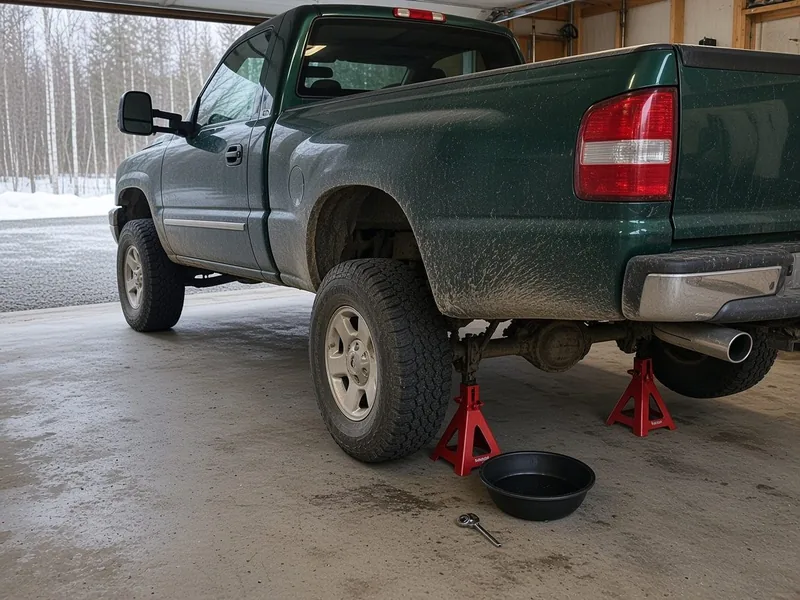
In my pre-winter six-fluid check and the freeze-up fluid guide, gear lube was fluid number six, and I promised a closer look. This is that post.
Differentials and transfer cases are the fluids nobody sees. There is no dipstick, no reservoir under the hood and no light on the dash. The gear lube just sits in a cast-iron housing under the truck and works: backing a boat trailer down a slick ramp at Big Lake, hauling a wheeler up a washboard gravel road, pulling the camper to a trailhead, or running the plow down the driveway at six in the morning. Because nobody looks at it, it gets forgotten.
I am Fredric Riech with 907 Synthetics in Wasilla. Here is the Mat-Su version: why our driving is hard on gear lube, when in the year to deal with it, what you can check in your own driveway, and when to let a shop take it.
Safety first: Any time you are under the truck, it sits on jack stands rated for the weight, on solid level ground, with the wheels chocked. Never rely on a jack alone. Your owner’s manual is the boss: the gear lube type, viscosity, fill level, procedure and service interval for your axle and transfer case come from the manufacturer, not from me or any blog.
Why Alaska Driving Is Hard on Gear Lube
Gear lube has a tough job to begin with. In a differential, the pinion and ring gear teeth slide and wipe across each other under heavy load, and the lube has to keep a film between them. Here is what we add to that up here:
- Towing and hauling. Boats, campers, snowmachine trailers and loads of firewood all mean more heat and load on the gears. Many owner’s manuals put frequent towing in a severe service schedule with a shorter gear lube interval, and plenty of Valley trucks spend their whole lives there.
- Boat ramps and water crossings. A hot axle backed into cold lake water cools fast, and as it cools it can pull water in past the seals or through the vent. Creek crossings on the way to a hunting spot do the same. Water and gear lube do not mix, and some owner’s manuals specifically call for changing the gear lube after the axle has been under water. AMSOIL says it does not support extended drain intervals wherever water contamination is possible.
- Gravel and dust. Summer on gravel roads means grit on every seal and vent. Dusty, dirty operation is another reason gear oil makers say to change it more often.
- Cold starts and long cold hauls. At forty below, gear lube in an axle that sat overnight is thick. Using the viscosity your manufacturer specifies matters here, and so does knowing the lube is actually full and in good shape before a long winter run to Fairbanks or the Kenai.
- Plowing and 4WD time. The transfer case and front axle hardly work in summer, then they work every snowy day all winter. Plowing with the truck is short, heavy, back-and-forth work in 4WD, and that is exactly when you want them in good condition.
When to Do It in Our Seasons
Two good times, and neither one is a January morning in the driveway:
- Fall, before freeze-up or the first plow day: the truck just finished a summer of towing, launching and gravel. Check it (and change it if it is due) in the garage before the transfer case and front axle start their winter work.
- Spring, after breakup and before boat season: if the truck did a lot of 4WD or plowing over the winter, or you know you are about to start launching boats every weekend, spring is a good time to check it, and to plan on checking again after a summer of ramps and creeks.
Whatever the season, the mileage or time interval comes from your manual. Look for the normal and severe service columns, figure out honestly which one you drive in, and use that one. If the axle has been under water, do not wait for the interval.
A Simple Driveway Check
Most of this you can do with a flashlight, a rag and a creeper. If you are going to stay under the truck or pull a plug, put it on jack stands first.
1. Look for leaks
Gear lube is thick and has a strong, sulfur-like smell you will not forget. Look at:
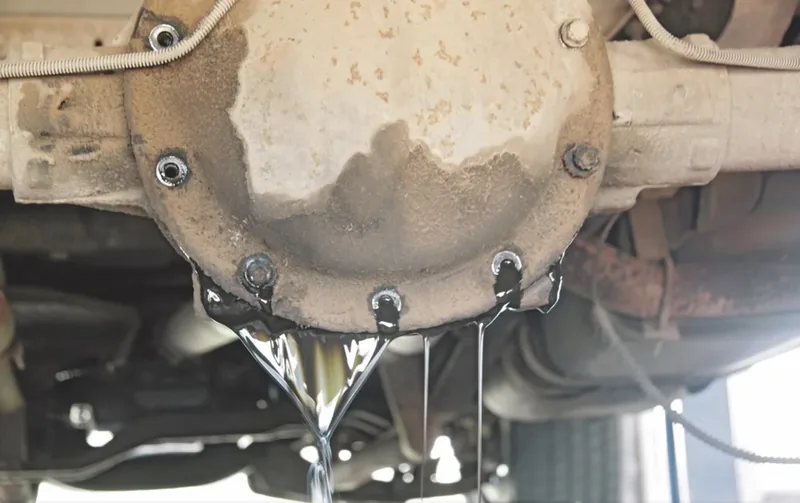
- The differential cover (on axles that have one). A wet, grimy ring around the edge of the cover points to the cover gasket or sealant.
- The pinion seal, where the driveshaft yoke goes into the front of the differential. Fresh wetness there, or lube thrown onto the underside of the truck, is worth watching.
- The axle seals at the outer ends of the housing. Check the inside of the wheel and the backing plate or brake parts. On a rear axle, gear lube on the brakes is a safety problem and a shop job.
- The transfer case, around its seams, output shafts and plugs.
A light film of grime that has been there for years is different from a fresh, wet drip. Wipe the area clean, drive a few days and look again. That tells you whether it is actually leaking now.
2. Check the vent
Most axles and transfer cases have a small vent so the housing can breathe as it heats and cools. It may be a little cap on the housing or a rubber hose running up to the frame. Make sure the hose is attached, not cracked or kinked, and not packed with mud. A plugged vent can push lube out past the seals. A hose that has fallen down low makes it easier for water to get in on the next ramp or crossing.
3. Check the level at the fill plug
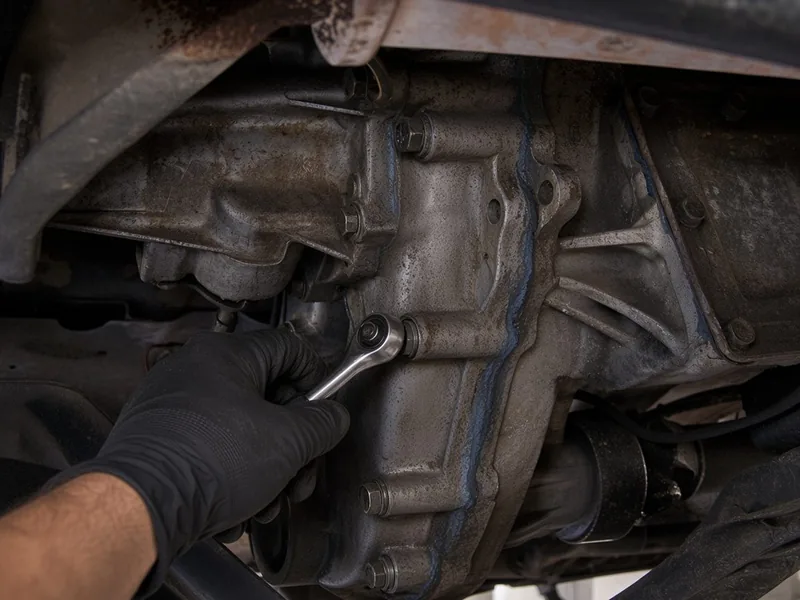
Most differentials and transfer cases are checked at a fill plug on the side of the housing, not with a dipstick. On a lot of GM half-tons, like a GMT800 Tahoe or Silverado with the 10-bolt rear, the fill plug is on the passenger side of the differential housing, up near the pinion. It is usually a 3/8″ square plug with no hex head: the square drive end of a 3/8″ ratchet fits right into it. Other axles put it on the cover or the other side. Your manual or a service guide for your vehicle will show you where.
- Truck level, on jack stands, wheels chocked. Clean around the plug first so dirt does not fall in.
- Break the plug loose with the right socket or square drive and a ratchet or breaker bar. Some plugs are very tight.
- On many housings, the lube should be right at the bottom edge of the fill hole, and a gloved fingertip just inside the hole should touch it. Some manufacturers specify a level a little below the hole instead, so check yours.
- Look at what is on your finger. Normal gear lube is a clear-to-brown oil. Milky, light-brown, or foamy lube means water got in. Heavy, glittery metal or chunks mean it is time to stop and have it looked at.
- Reinstall the plug, tightened to the manufacturer’s spec.
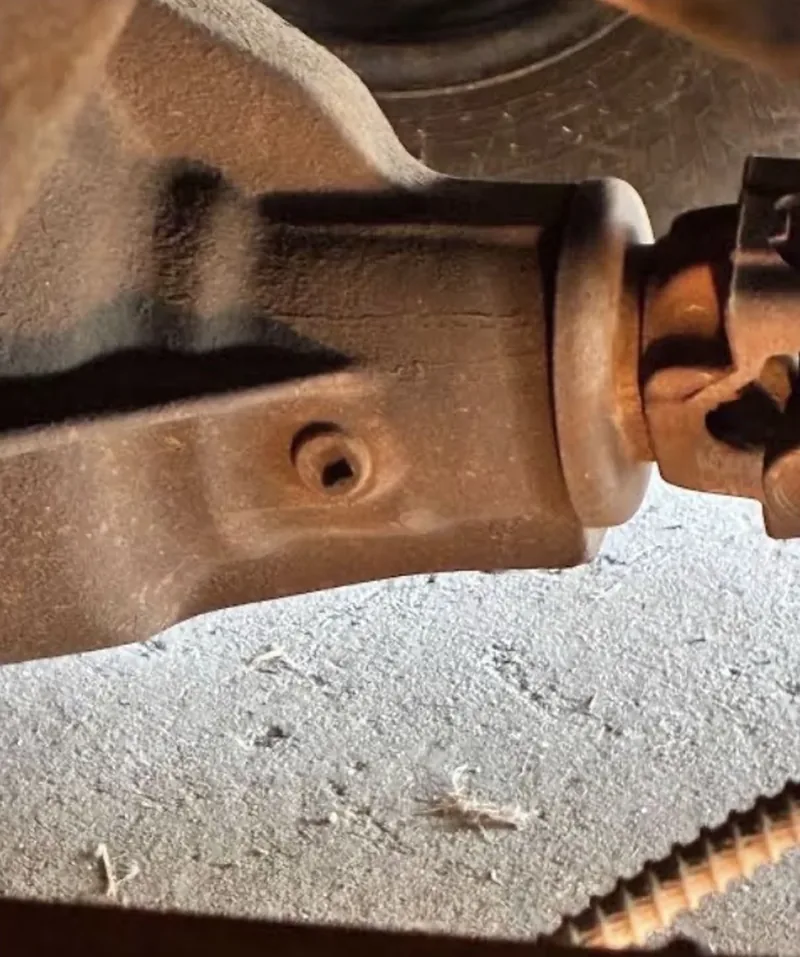
The one rule every old-timer repeats: always loosen the fill plug before the drain plug or the cover. If the fill plug is seized or stripped, you want to find out while the housing is still full, not after you have drained it and can’t refill it.
If You Are Changing It Yourself
A differential fluid change is a reasonable driveway job on a lot of common trucks, as long as you have the right lube and your manual’s procedure. I am not going to rewrite a full step-by-step for every axle. Here is what the job looks like with ordinary tools:
- Tools: jack and jack stands, wheel chocks, a wide drain pan, sockets and a ratchet or breaker bar, a gasket scraper, rags and brake cleaner, a new cover gasket or the sealant your manual calls for, and a hand fill pump or squeeze bottle for refilling.
- Drain: some housings have a drain plug. Many common rear axles, including a lot of GM and Ford half-tons, do not. On those you drain by pulling the cover. Before you remove the cover, make sure you can break the fill plug loose first. Then loosen the cover bolts, leaving a couple at the top in place, and gently prying the bottom of the cover so the lube runs into the pan. Gear lube is slow, especially in a cold garage, so give it time.
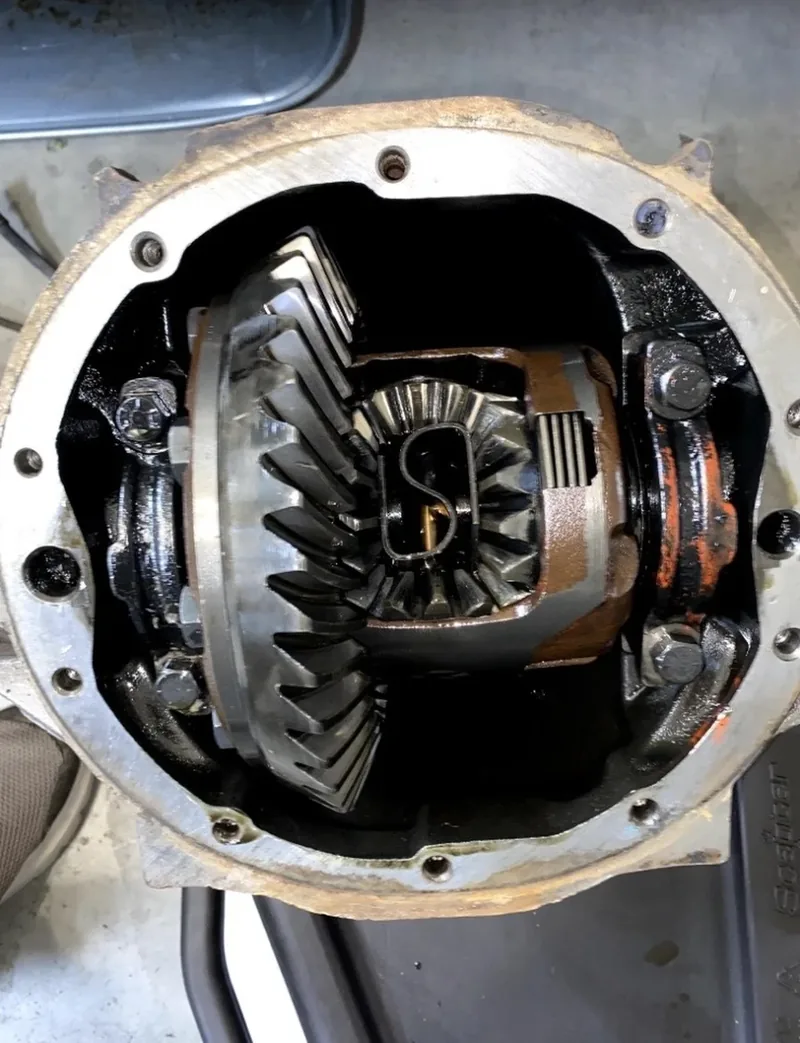
- Look while it’s open: a little fine gray paste on a drain plug magnet is normal wear. Milky lube, chunks or chipped gear teeth are not. Those are a reason to stop and call a shop.
- Clean and seal: scrape both mating surfaces clean and dry, put the cover back on with a new gasket or sealant, and tighten the bolts evenly in a cross pattern to spec.
- Refill: pump lube in through the fill hole until it reaches the level your manual specifies (on many axles, until it just starts to come out of the hole), then reinstall the fill plug to spec. If your axle is a limited-slip, read the next section before you buy anything.
Limited-Slip, Lockers and Friction Modifier
This is where people get into trouble. Some limited-slip differentials use clutch packs, and those clutches care about the friction properties of the lube. If the lube is wrong for that differential, you can get chatter: a shudder or groan in tight, slow turns, like backing into a parking spot. Some manufacturers call for a friction modifier added to the gear lube in a limited-slip axle, others do not, and some lockers have their own requirements.
AMSOIL says its synthetic gear lubes are limited-slip capable and usually don’t need an extra friction modifier, and it makes an additive called Slip Lock® for the times a mechanically sound limited-slip still chatters. Even so, start with your manual. If your axle has a code that says limited-slip or locker and you are not sure what it needs, that is a good time to call me or ask a shop before you fill it.
Transfer Cases and AWD: Check Before You Assume
Transfer cases vary more than axles do. Depending on the make, model and year, a transfer case might take automatic transmission fluid, a specific manufacturer transfer-case fluid, or gear oil, and putting gear oil in a case built for ATF, or the other way around, is a real way to hurt it. Shift-on-the-fly and automatic 4WD units have clutches and synchronizers with their own friction needs.
- Most part-time 4WD pickups and SUVs have a fill plug and a drain plug on the transfer case. The same fill-before-drain rule applies.
- Check the level at the fill plug the way the manufacturer describes, and use exactly the fluid it specifies.
- Many AWD cars and crossovers have a power transfer unit or rear drive unit that is hard to reach, has an unusual fill procedure, or is called “sealed” or “filled for life.” If yours is one of those, that is a shop job. “Filled for life” often still has a severe-service interval in the fine print.
When to Hand It to a Shop
There is no prize for doing all of this yourself. Let a shop take it if:
- Gear lube is on the brakes, or an axle seal is clearly leaking.
- The lube is milky, or full of chunks or metal, or the axle whines, howls or clunks.
- It is a limited-slip or locker and you are not sure what fluid or friction modifier it needs, or it chatters even after a fluid change.
- It is a sealed unit, an AWD drive unit, or a transfer case with a special fluid or fill procedure.
- The fill plug is seized or the threads are damaged.
- You don’t have a good level place to get the truck safely on jack stands.
Supplies and Ordering, the Local Way
The first step is always the same: find out exactly what your axles and transfer case call for. Look up your vehicle in the AMSOIL Product Guide and compare it to your owner’s manual, and the manufacturer spec wins if they disagree. Many trucks have different requirements front, rear and in the transfer case.
If you order through AMSOIL, ask me about becoming a Preferred Customer before you check out. In the Anchorage area, AMSOIL orders can be picked up at Carlile, 1930 Spar Ave., Anchorage. Per AMSOIL order confirmations, pickup orders are generally ready in about 2 hours. More on that in how to buy AMSOIL in Alaska. Wasilla and Palmer folks, I am local. Call or text and I will help you sort out front, rear and transfer case before you order.
Gear Lube Checklist
- Leaks: cover, pinion seal, axle seals and transfer case dry, with nothing on the brakes
- Vents: hoses attached, not cracked or plugged, routed up high
- Level: checked at the fill plug, on level ground, per the manufacturer
- Condition: no milky lube after ramps or crossings, and no chunks
- Interval: normal or severe column. If you tow, you probably drive in severe service.
- Fluid: exact viscosity and spec for each unit, plus friction modifier needs for limited-slip
- Safety: jack stands every time you are under it
Gear lube is easy to forget because it never complains until something is wrong. Twenty minutes with a flashlight now can save you a ruined axle later. If you tow snowmachines this winter, check your trailer bearings while you are at it.
Fluids for This Job
For differentials that call for a 75W-90 GL-5 gear oil: AMSOIL SEVERE GEAR® 75W-90 100% Synthetic Gear Lube is AMSOIL’s severe-duty gear lube for towing, hauling, plowing and off-road use. AMSOIL lists it as containing friction modifiers for limited-slip applications. Other viscosities are available if your manual calls for something different. Match the viscosity and spec to your manual.
For a clutch-type limited-slip that still chatters: AMSOIL Slip Lock® Differential Additive. AMSOIL says its synthetic gear lubes don’t usually need it, and it is not for automatic transmissions or anything that takes ATF.
For transfer cases that call for ATF: AMSOIL Signature Series Multi-Vehicle 100% Synthetic Automatic Transmission Fluid. Only use it where the AMSOIL Product Guide lists it for your exact transfer case, because many cases need a different fluid. These links carry my dealer number so AMSOIL credits 907 Synthetics with your order.
Related: The pre-winter six-fluid check · Alaska freeze-up fluid guide · Repack your trailer bearings
Not Sure What Your Axles Take?
Front axle, rear axle and transfer case can all need different fluids, and limited-slip adds another question. Give me the year, make and model and I will help you look it up and get the order right, including Anchorage pickup. No pressure, just local help from a fellow Alaskan.
Call or text 907-350-7366 — Fredric Riech, 907 Synthetics, Independent AMSOIL Dealer, Wasilla, AK
Did this help? Leave 907 Synthetics a Google review. It helps other Valley folks find local help.